Mitochondrial variant detection
Detection of variants in the mitochondrial genome is performed in the Genomics England Rare Disease bioinformatics pipeline with the DRAGEN small variant detection software.
The detection algorithm utilises a continuous allele frequency model. Given that there are many copies of the mitochondrial genome per cell, the continuous allele frequency model is more appropriate for mitochondrial variant detection as it assumes that the variant allele fraction can vary between 0–100% and facilitates detection of low level heteroplasmy.
The Genomics England Rare Disease bioinformatics pipeline will consider small mitochondrial variants for prioritisation during variant tiering if they are present at ≥5% allelic fractions.
Information relevant to how variants will be presented in the Interpretation Portal, if they are prioritised, are included below:
| Variant state | Allele Fraction | Genotype representation in VCF |
|---|---|---|
| Heteroplasmic | ≥5% and <95% | 0/1 |
| Homoplasmic | ≥95% | 1/1 |
Heteroplasmic variant detection sensitivity (limits of detection) within the Genomics England Rare Disease pipeline was assessed to be 100% (95% Credible Interval = 95.7-100%) for variants present at ≥5% heteroplasmy. This analysis considered 43 variants that were proven through orthogonal standard-of-care testing to be at ≥5% heteroplasmy.
Measurement uncertainty analysis for heteroplasmy level estimation demonstrated that 95% of mitochondrial variants are within 6% of the heteroplasmy values determined through orthogonal standard-of-care approaches.
Variants included in limits of detection and measurement uncertainty analyses were selected to cover a wide range of heteroplasmy values. The full range of heteroplasmy values and tissue types considered in this analysis is included in the figure below.
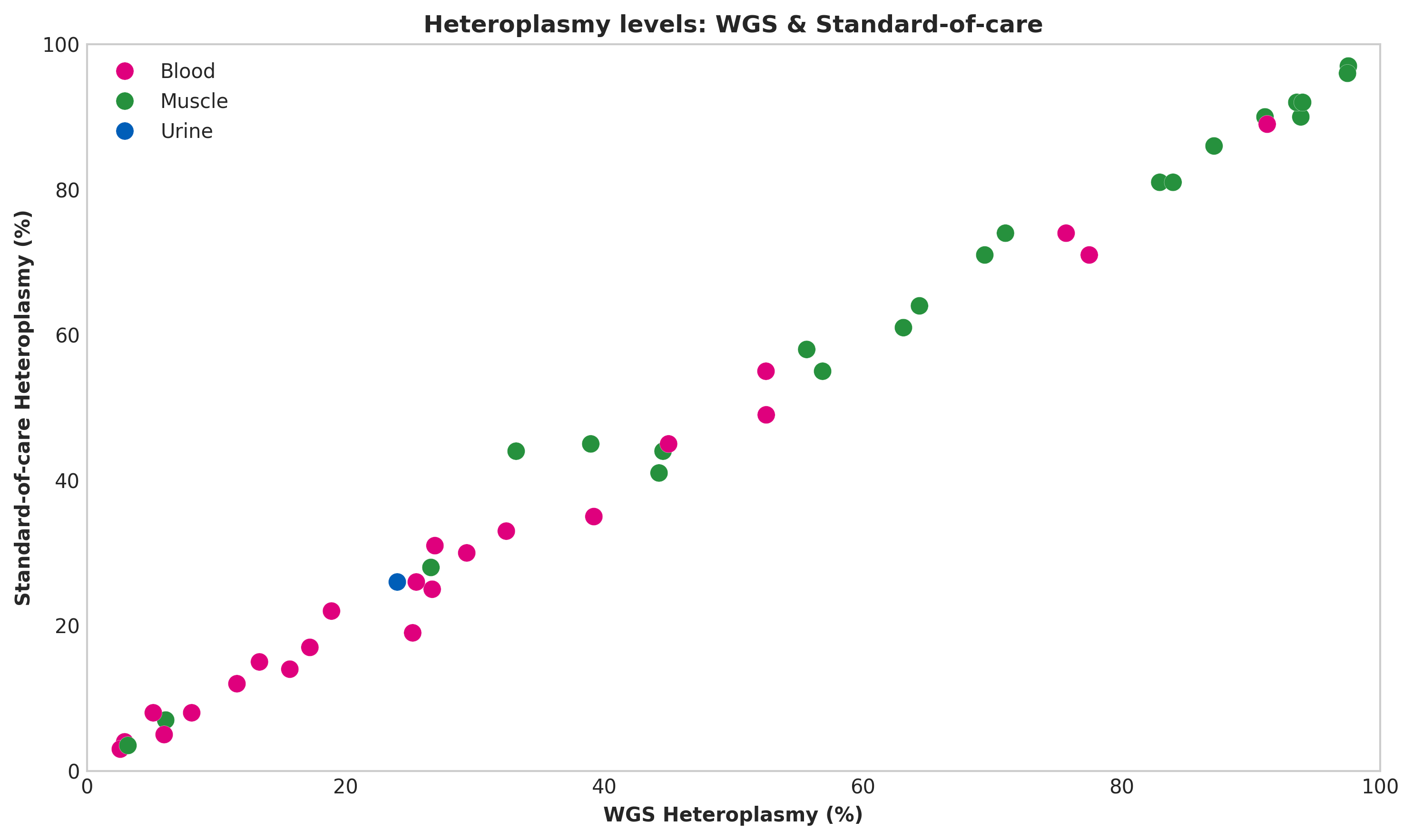
As expected, there is a general trend towards higher heteroplasmy values for mitochondrial variants detected in muscle samples than in blood samples. The analysis described here, and considered for accreditation of the Genomics England Rare Disease bioinformatics pipeline to detect mitochondrial variation, is independent of the sample type origin of the DNA utilised for whole genome sequencing.