Overview
Copy number variants (CNVs) are detected using DRAGEN CNV (v3.2.22) with self-normalisation and the Shifting Level Models (SLM) segmentation mode. High quality CNVs >10 kb in size are defined as those detected by DRAGEN CNV with filter status PASS. CNVs between 2 and 10 kb in size are identified by combining the results of DRAGEN CNV and Manta (v1.5) SV callers. CNVs in this range detected by both callers with a minimum reciprocal overlap of 50% are deemed to be high quality. The Genomics England Rare Disease Interpretation Pipeline currently annotates and reports all high quality CNVs ≥ 2 kb in size.
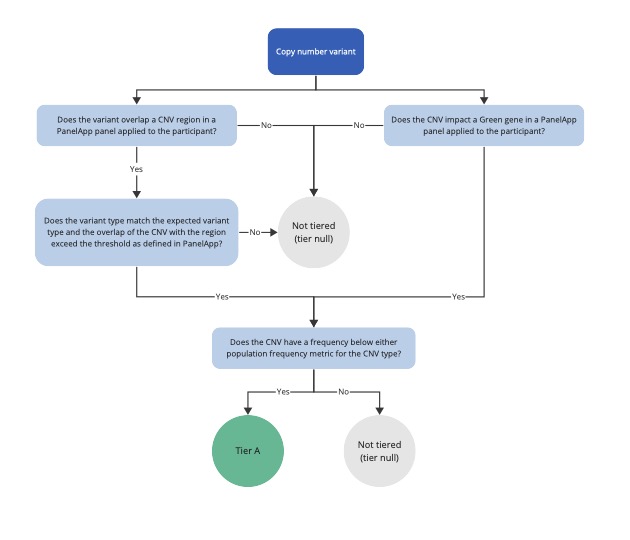
An overview of the CNV tiering pipeline can be seen below.
Only CNV calls from the proband are annotated and displayed. CNV calls in relatives are not currently considered in tiering; this feature is in development for future versions of the pipeline. However, visual assessment of CNVs for all family members can be performed using coverage profiles displayed in the IGV viewer following the links from the Interpretation Portal.
The annotations, including internal allele frequencies, for all PASS Gain and Loss calls are displayed in the Interpretation Portal. All PASS calls are assigned a tier, either Tier A or Tier null.
All PASS CNVs are categorised into two tiers:
Tier A
A CNV is assigned Tier A if it satisfies one or both of the following criteria:
- The CNV overlaps a pathogenic region in a virtual panel applied in the analysis, the overlap is above the threshold defined in PanelApp for that region, and the variant type matches (i.e., loss or gain) that of the region in PanelApp.
- The CNV overlaps with a green gene in a panel applied in the analysis. All CNVs overlapping any gene are considered, without requiring a minimum overlap threshold. Variant type (i.e., loss or gain) is not considered.
In addition, the following criteria must be satisfied: - The CNV has a frequency below the threshold for either of the CNV frequency metrics (CNV_AF, CNV_AUC) for its CNV type: - LOSS: 0.005 - GAIN: 0.01
Tier null
All PASS variants that do not satisfy either of the Tier A conditions.
Note
Mode of inheritance is not considered in CNV tiering. In contrast to small variant tiering, a single heterozygous CNV within or impacting a gene or region (with appropriate variant type and overlap) will be tiered regardless of the expected mode of inheritance recorded in PanelApp.