STR visualisation
Whenever an STR is reported, a visualization plot of the reads (pile-up) supporting the expansion is provided within the Interpretation Portal. Reviewing this plot is fundamental to the process of assessing the quality of the repeat size estimations computed by ExpansionHunter. Genomics England strongly advises GLHs to use the visualization plot to assess the quality of each call before validation of expansions with an alternative method. It is also advised to review normal alleles of the sizes larger than the read length (e.g. >49 repeats for trinucleotide repeat loci) and normal alleles very close to the threshold (e.g. +/- 2 repeat unit)
Analysing the reads that ExpansionHunter considers when assessing the repeat lengths is essential for determining the quality of the call but also for characterising interruptions (i.e., for Spinocerebellar Ataxias) or pathogenic-borderline cases, before orthogonal confirmation.
Below are visualisation plots and scenarios to illustrate how Expansion Hunter estimates STR genotypes.
A good quality STR call showing alleles within the normal range
An example of a visualisation plot that illustrates the reads used by ExpansionHunter when estimating expansions
in HTT is shown in below. Both alleles have an STR repeat-length of 22 and accordingly, reads
each containing the CTG motif 22 times are visible.


A good quality STR showing one allele within the normal range and one expanded allele
An example of a visualisation plot illustrating the reads used by ExpansionHunter when estimating expansions in HTT is shown below. Alleles of 24 and 47 repeat-lengths are shown in the plot which is divided into 5 subplots:
(Genotype≥0): There are "flanking reads” that are anchored only on one side of the repeat. These support more than 0 repeats but cannot be used to determine the exact number of repeats.(Genotype=24): There are “spanning reads” that are anchored on both sides of the repeat and support exactly 24 repeats for one of the alleles.(Genotype≥24): There are additional flanking reads that support more than 24 repeats for the second allele but again cannot be used to determine the exact number of repeats.(Genotype=47): There are spanning reads that support exactly 47 repeats for the second allele.(Genotype>≥47): There are “in repeat reads” that are not anchored at either end of the repeat and support at least 47 repeats. Note: these reads do not contradict 47 repeats.

A good quality STR call with interruptions
An example plot with the reads used by ExpansionHunter when estimating expansions in ATXN1 is shown below. Interruptions
(ATG rather than CTG) in the reads containing the ATXN1 repeat motif are visible (red boxes in figure). In certain
disorders (i.e., ataxias) it is important to use the visualisation plots to check for such interruptions.


A poor quality STR call
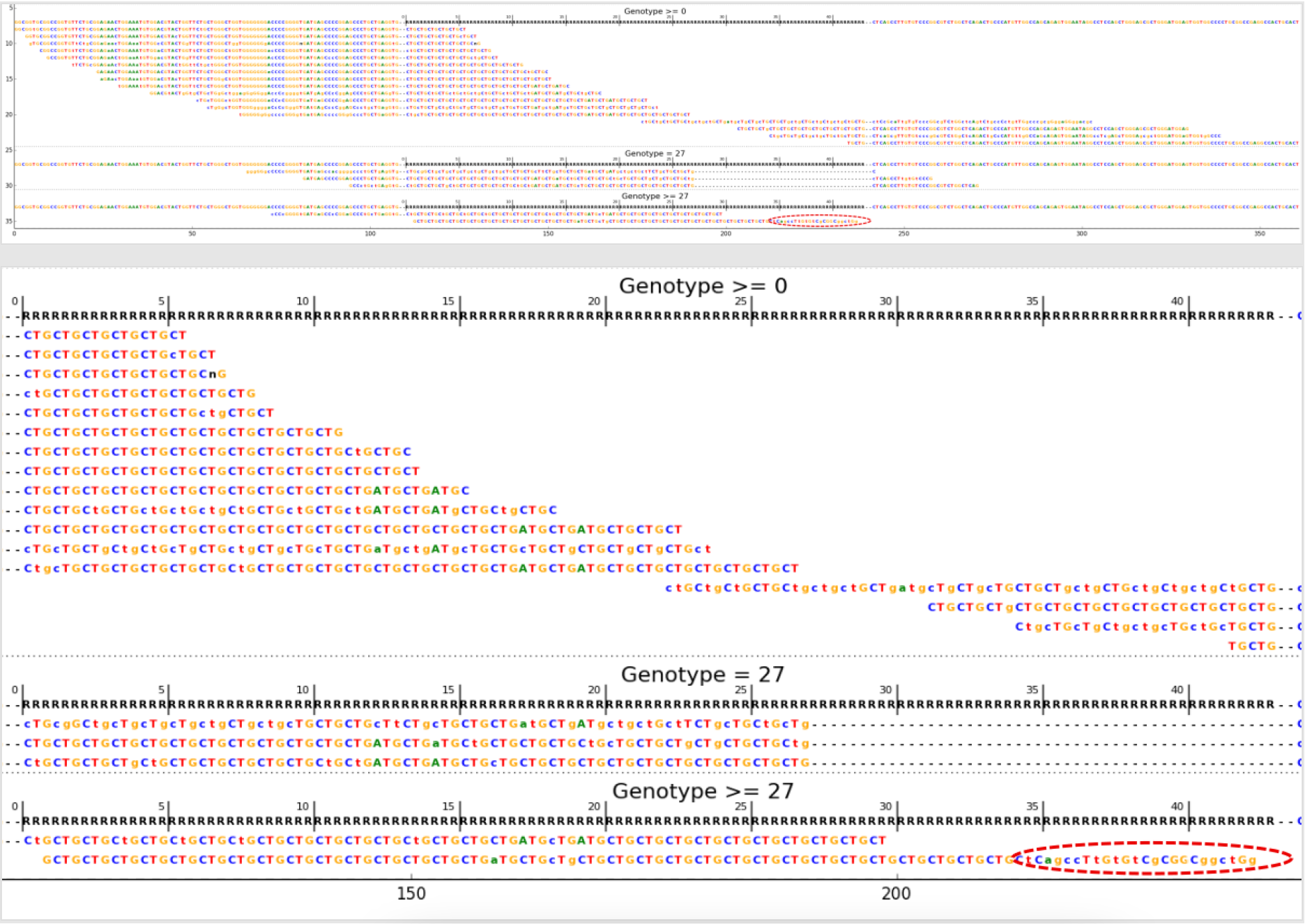
An example plot showing the reads used by ExpansionHunter to estimate expansions at ATXN1 (with alleles of 27 and 43 repeat lengths) is shown below.
The reads supporting the 27 CTG allele are clean good quality reads.
However, for the 43 repeat-length allele, bad quality bases are visible at the end of the read. Bad quality bases within a read are shown in lowercase, while good quality bases are uppercase.
Furthermore, in this case the lower-quality bases do not follow the CTG motif. In this case, it is likely that
ExpansionHunter should have estimated an allele containing 30-35 repeat-size motif rather than 43.